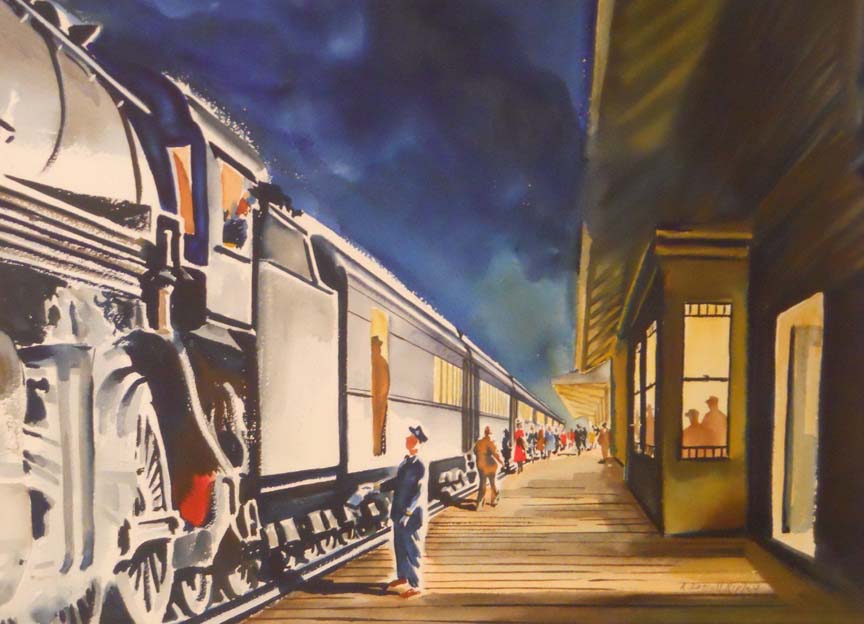
AIDEN LASSELL RIPLEY
"TRAIN STATION"
WATERCOLOR, SIGNED
AMERICAN, C.1940
14 X 19.5 INCHES
Aiden Lassell Ripley 1896-1969 Ripley was born at Wakefield, Massachusetts, on December 31, 1896, and began painting at age seven or eight. Son of a horn player for the Boston Symphony Orchestra, Ripley was an accomplished pianist and tuba player, and for a time his career choice hovered between music and art. Finally, he enrolled at the Fenway School of Illustration in Boston. Ripley enlisted in the Allied Expeditionary Force in 1917 and was sent to France. His talent as a tuba player landed him in General Pershing's band, which was safe enough during the conflict, but he was kept in Europe long after most of the soldiers had gone home. Ripley returned to Boston in April, 1919, and afterward established a home and studio in Lexington, Massachusetts. He won a scholarship to the School of the Museum of Fine Arts, Boston, where he studied under Philip Hale, Edmund Tarbell, and Frank W. Benson, the water and wildlife artist. He was awarded a two-year Paige Traveling Fellowship, which allowed him and his wife Doris Verne to visit France, Holland and North Africa in the early 1920s. On subsequent trips he visited Normandy, Brittany, and Scandinavia. On his return he exhibited his European watercolors, which attracted favorable notice. In 1928 he was awarded a Logan Purchase Prize and Medal by the Art Institute of Chicago, which was the first of more than fifty prizes he would receive. During the Depression, Ripley supplemented his income by teaching drawing at the Harvard School of Architecture. Because demand for his customary landscapes was waning. In 1936 he began a relationship with the Sportsman's Gallery of Art and Books in New York City. It was as a painter of hunting and angling scenes that Ripley was to achieve his greatest success. By the 1950s he was considered the nation's preeminent watercolorist in that field. Sportsman's Gallery arranged for him to take hunting (and painting) trips to upper New England in the summer or autumn, and to Florida, Georgia, and South Carolina in the winter. Ripley was also a muralist. A 1939 mural for the Lexington Post Office led, in the 1950s, to a commission to paint the life of Paul Revere in twelve large oils, which he completed in 1965. He did about thirty etchings and drypoints, and in the last years of his life was active as a portraitist. Ripley was a member of the National Academy of Design, the American Society of Watercolor Painters, the National Society of Mural Painters, and the Guild of Boston Artists, of which he was president from 1957 to 1968. He died in September, 1969. His work is represented at the Art Institute of Chicago, the High Museum in Atlanta, and the Museum of Fine Arts, Boston, which had a show of his work in 1942. A retrospective exhibition was sponsored by the Guild of Boston Artists in 1970. Ripley liked to execute his watercolors from rapid pencil sketches done in a notebook, the more complete the better. Often he did six or seven drawings or studies for each watercolor. In many cases he then did a tonal charcoal study overlaid with opaque watercolors. He painted the sky first, then whatever came against the sky. This relationship dictated the remaining composition. He relied on memory of the locale to supply the choice of colors. His palette was not extensive: two blues, two reds, three yellows, an orange, green, two browns, indigo, black, and white.
|